
Salt Works
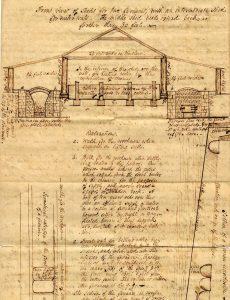
Salt production was undoubtedly one of the earliest industries in northeastern Kentucky and was perhaps the earliest in Carter County on a commercial scale. Salt production was taking place on the Little Sandy River by 1801, less than ten years after Kentucky statehood. Two early figures in this industry in the Grayson area were Amos Kibbe and his partner Jesse Boone, son of none other than the well-known frontiersman Daniel Boone. By the late 1810s, a contemporary observer estimated that the Little Sandy Salt Works near present-day Grayson produced 10,000 bushels (approximately 300 tons) annually.
At their simplest, these operations located brine springs in the river, pumped that water in large cauldrons or kettles, then boiled off the water to obtain salt. This could be done on a small scale for the needs of a family, or on a commercial scale by operations employing dozens or hundreds of men. Once obtained, the salt could be sold locally or shipped via flatboat down the Little Sandy to larger markets on the Ohio River.
The salt works on the Little Sandy River seem to have had their heyday in the first half of the 1800s, but salt production still took place, though perhaps on a smaller scale, in the later decades of the nineteenth century. Documents pertaining to the Lansdowne plantation just south of Grayson record salt production on their land in the 1850s and 1860s and salt works at Grayson appear on two maps produced in the 1860s. Following the Civil War, industrial salt production was increasingly corporatized and concentrated elsewhere while other industrial activities in Carter County proved more lucrative.